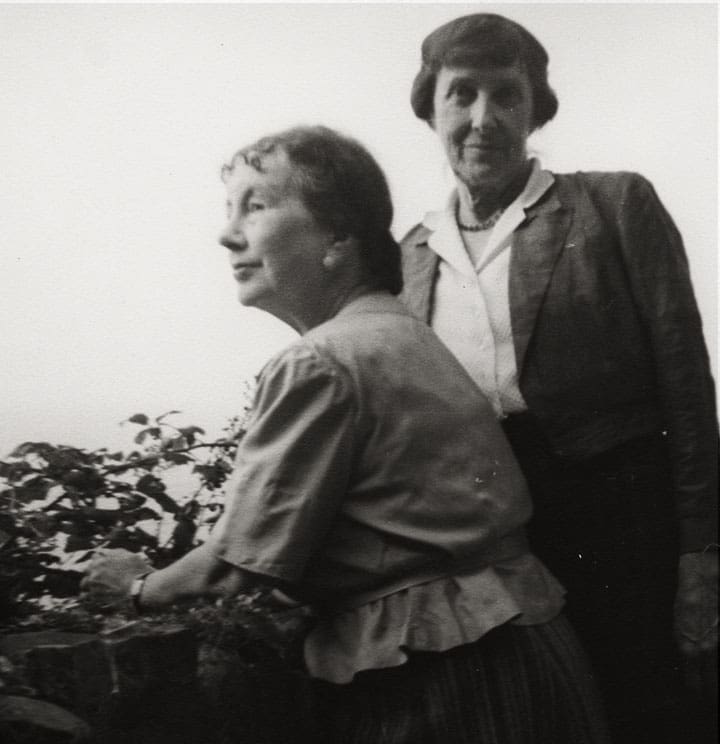
St Brannock’s church in Braunton, North Devon, was once a place of pilgrimage, rather like Canterbury Cathedral though obviously on a much smaller scale. It was a place of pilgrimage too for Mary Stella Edwards and Judith Ackland in June 1922 – but they were rather more interested in the palimpsest brass than in St Brannoc, the sixth-century Welsh saint. And in September 2026 it was a place of pilgrimage for me as well – to find the palimpsest brass that inspired Edwards’ sonnet ‘Pilgrimage’, and to attempt to retrace their steps in the fields above the town that day in 1922.
‘Palimpsest brass – unusual – don’t miss it’
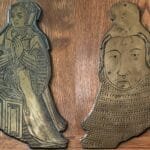
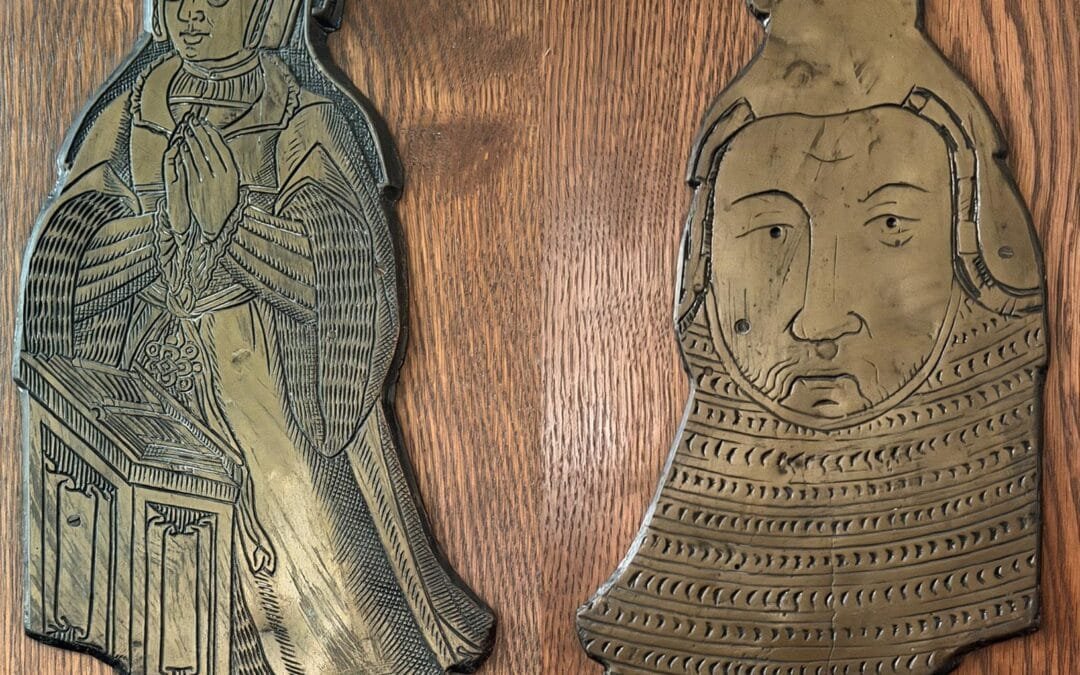
A palimpsest is something that has been reused that still shows a trace of its earlier form. For example, in the days of writing on vellum or parchment – a writing surface made from animal skins – the sheets could be re-used after scraping off the top layer. The older writing would often show through the new layer of text. The brass in Braunton is double-sided palimpsest, but this was hidden for centuries, because it was set in the floor of the church. When the brass was taken up in 1908, a completely different image was found on the other side. On one side is a praying woman in a head-dress, with a 1548 inscription to Elizabeth Bowcer set below. On the other side is a rather worn-looking knight’s head wearing armour, from around 1200.
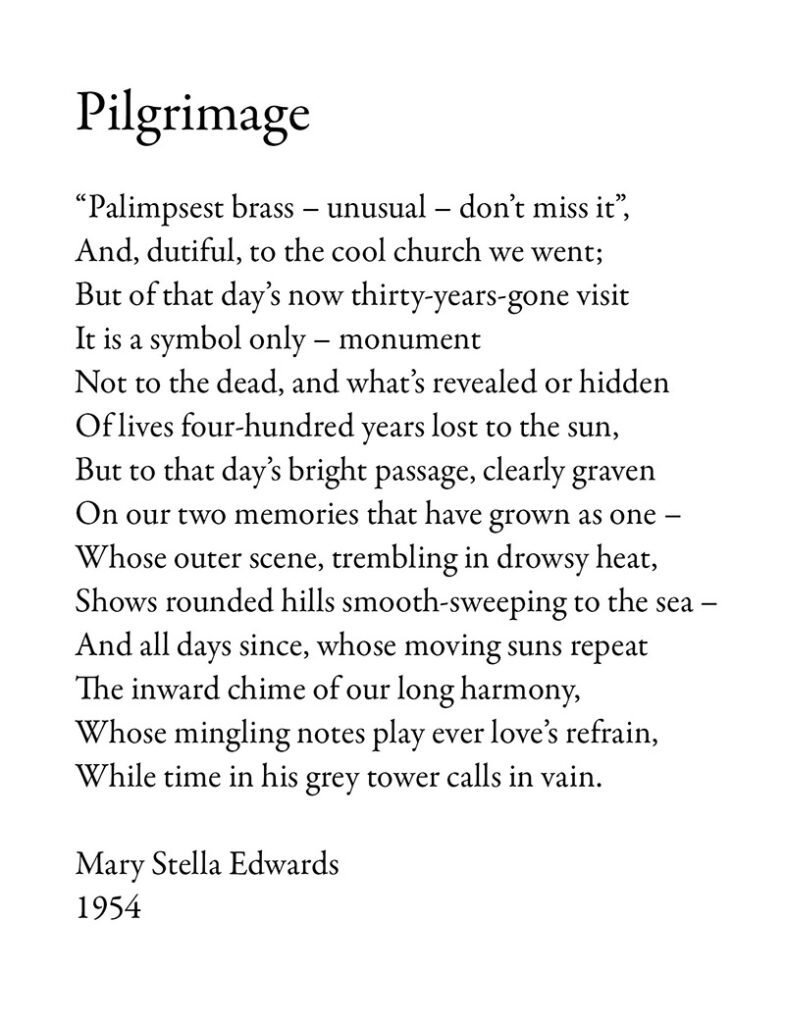
I could find very little further information about the palimpsest brass. The church guides are more excited by the bosses and the pew ends. But in fact it doesn’t really matter. It’s not that important, because for Mary Stella Edwards the brass is ‘a symbol only’ – or a metaphor which she uses repeatedly to great effect in the poem. And in an odd way my small pilgrimage added yet another layer to the palimpsest history.
Thwarted plans
Edwards’ poem ‘Pilgrimage’ suggests the two women spent a golden carefree day together in and around Braunton. On one level that is certainly true, but Edwards’ letters and journals reveal a slightly more complicated history. In May 1922 the Edwards family planned a holiday, starting at Lyme Regis then going on to Ilfracombe. Judith quickly wrote to invite Mary Stella to spend a few days with her in either Bideford or The Cabin in Bucks Mills, while her parents were in Ilfracombe. Mary Stella was delighted and accepted immediately… only to write again a few days later, bitterly disappointed, to say that their plans had been dashed by her parents. They were, it seems, terrified for their daughter’s health.
Although neither ‘TB’ or the post-war flu pandemic are explicitly mentioned in Mary Stella’s letter, Madeline’s death the previous October and Jean’s death the year before that, seems to have rattled the Edwards parents. What if Judith became ill at the cottage ‘with no doctor within miles’? (A tad insensitive, given that Judith’s father was the local doctor.) And, they added, the whole family was recovering from various forms of influenza making Mary Stella more susceptible to further illness.
‘I feel wretched either way;’ she wrote, ‘but trust you to blame, if you blame anything, their care of me in every detail and at all times.’ Instead, she suggested that they meet somewhere between Bideford and Ilfracombe for the day.
A day in Braunton
Credit: www.disused-stations.org.uk
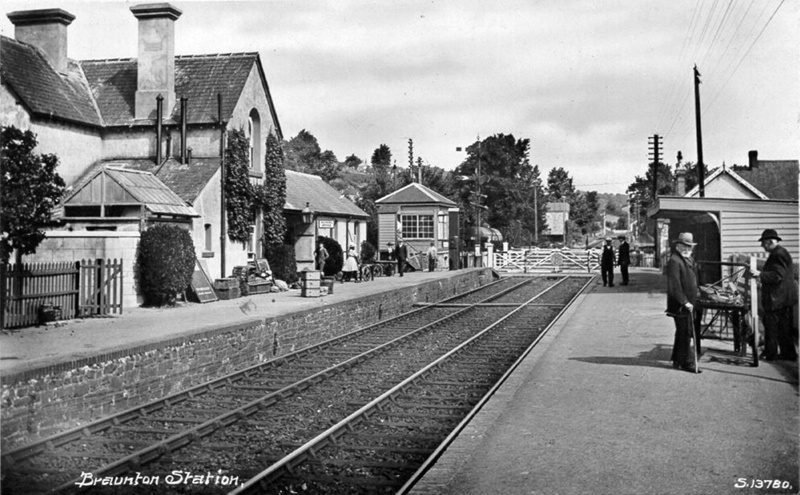
Mary Stella and Judith actually managed to spend two days together: first in Ilfracombe (uneventful), then a few days later they met again at Braunton station. Their day together wasn’t quite the ‘bright passage’ suggested by Edwards’ poem. The palimpsest brass gets barely a line in Mary Stella’s journal (no mention of the pew ends or bosses) and they were quickly outside again heading up a steep lane looking for woodland and a possible stream.
They had one of those country walk experiences that will be familiar to almost everyone in North Devon – taking a wrong turn, tramping across fields and through gates, finding a rubbish dump, walking across more fields, and then ending up back on the same lane they started on only quarter of a mile further up! But their adventure had only just begun. The way was now barred by a gate, with stampeding cows in the field beyond and a lad of about 14 running around and shouting on the hill above. Judith called up several times to ask whether they could access a ‘delightful little field with hawthorn hedges and a view of the opposite hills seen through poplars’. With no response from the boy who now appeared to be hiding in a gorse bush, they went in anyway and sat down to look at Judith’s latest drawings.
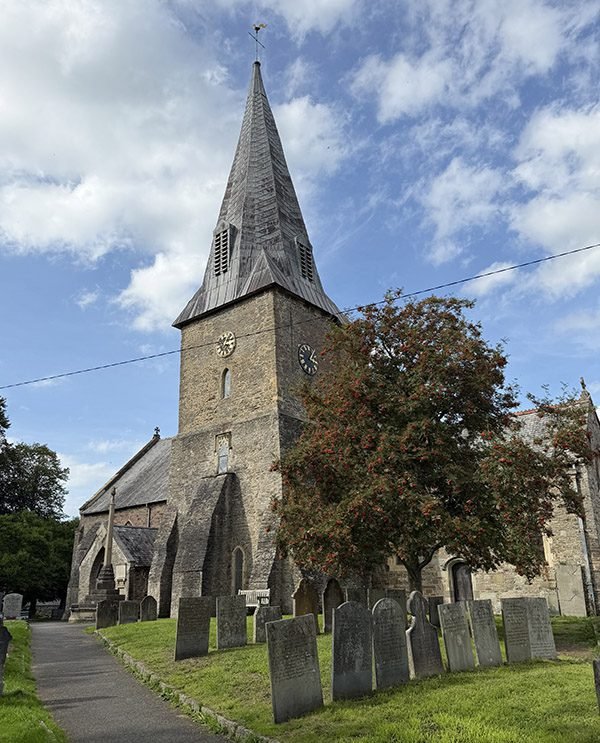
Time’s grey tower?
All was great for about ten minutes, and then missiles started crashing through the hedge above them. At first, they put this down to a ‘disagreeable joke’, but the missiles turned out to be stones rather than mangelwurzels as they had first thought, and one just clipped Mary Stella’s shoulder. Then the boy started swearing and shouting at them and more stones followed. Judith said firmly: “Now stop that!” at regular intervals as they beat a hasty retreat in as dignified and unhurried a manner as they could muster. This was difficult as their ‘retreat lay under a hurdle and over brushwood, across two boggy streams, and through another gate into the lane’ all while the boy was shouting after them ‘how did you like the stone?’
Fortunately, their day now improved as they found a calmer spot to eat lunch and talk for a few hours. From there it was easy enough to reach the ruined church on the hill and admire the view across the Taw and Torridge estuaries. Then they dropped down from the field bank – Mary Stella describes a drop of about 10 feet while clinging to an ash branch – and walked back into Braunton to drink ‘a great deal of dry ginger ale’ at the New Inn pub. They parted on trains going in either direction just four minutes apart – Judith back to Bideford and Mary Stella to Ilfracombe. Mary Stella described it as ‘a day in which our thoughts “spread about” rather, but which was happier perhaps than the compressed idea of London…’
Spot the palimpsest!
A good sonnet is rather like a pocket watch – with all its gears and workings ticking away perfectly out of sight. A bad sonnet is a piece of steampunk costume jewellery – clunky, all the cogs showing but none of them connected. I didn’t need to read Mary Stella’s journal account, or to visit Braunton to appreciate the quality of this poem… but I must confess that they have deepened my understanding and love for it.
Let’s play ‘spot the double-sided palimpsest’!
First there’s the actual brass palimpsest (still there, still unusual, still worth a visit) – then Mary Stella makes a transition. She reveals that the palimpsest is a symbol of something else, and drops in the idea of things being revealed and hidden at the same time, which is key to much of what follows. The second palimpsest is death (the ‘lives four-hundred years lost to the sun’) and life (her and Judith’s bright living experience). Hanging on the coat-hook of this death and life palimpsest is the darkness of death and the gloomy interior of the church, and the light of living and the sun outside.
Palimpsest three is a lovely one: Mary Stella’s memory of the day and Judith’s memory of it – ‘grown as one’. Number four is the contrast between the outer world (the ‘rounded hills’ and the sea) and their joint inner world, in which this bright day is a step towards them building their long harmonious relationship. The fifth and final palimpsest is in the volta (pay-off) in the last two lines: the harmony of the mingling notes of their love on one side, against the powerlessness of time in his grey tower. And now I can’t help but visualise the grey tower of St Brannock’s church.
Edwards hides the workings of this Shakespearean sonnet (three sets of four lines, with the two line pay-off at the end) with a whole series of enjambed lines running not just across line-endings, but across the structure of the whole sonnet. This gives it forward momentum, and a feeling of inevitability. It’s a jewelled pocket watch of a poem.
Pilgrimage 2026
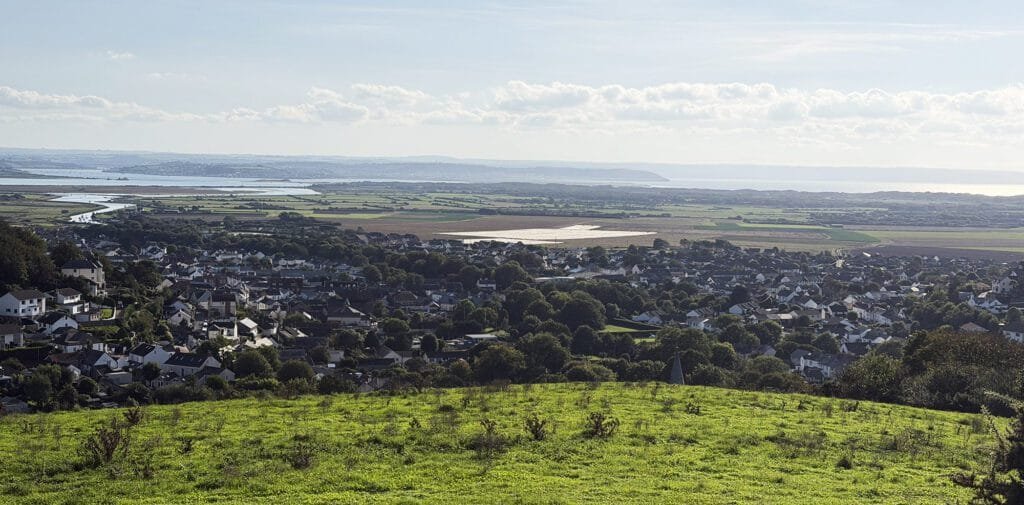
When I read the journal entry I found a sixth palimpsest: the reality of that day in June 1922 on one side, and the way Mary Stella remembered the day over thirty years later as she wrote the poem on the other. The journal entry is so detailed I was fairly sure I could find where Judith and Mary Stella walked that day.
I parked at the Caen Street carpark, which by chance is the site of the old Braunton railway station. The Barnstaple to Ilfracombe line closed in 1970, and Braunton is now the site of monumental traffic jams with cars negotiating multiple junctions and traffic lights. I bought some snacks at the newsagent, which used to be one of the original station buildings, then walked along the old railway line (now part of the Tarka cycle trail) to St Brannock’s church. It took some time to find the palimpsest brass. If you visit, you’ll find it on the south wall quite close to the altar. I hadn’t realised how old it would be.
Coming out of the church I came face to face with a lad of about 14 (I know – what are the chances?) who was having a massive row with his mum on the phone. He was leaning against the war memorial with an electric scooter on the ground at his feet, screaming and swearing at her to pick him up as the battery on the scooter had gone flat. I did consider saying firmly, ‘Now stop that!’ in a Judith style (his poor mother!). But he was so angry he could have uprooted the gravestones and hurled them at me, so I chickened out and beat a hasty and, I hope, dignified retreat towards the Black Horse pub.
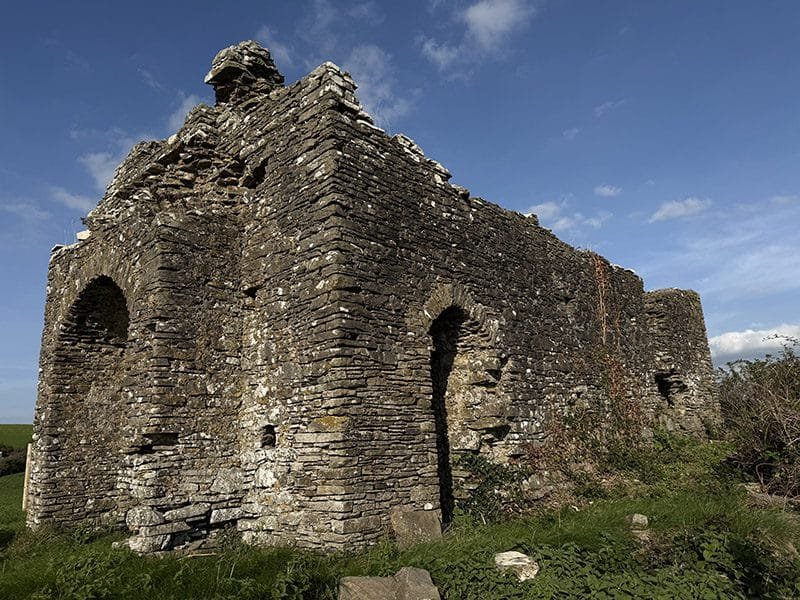
The hikers’ map that I picked up from the Countryside Centre (both recommended) showed a permissive path to the church ruin on the hill. But to get there I had to walk through a tidy housing estate with street names such as Chestnut Avenue, and Sylvan Way, suggesting this valley was once woodland. I reached the fields surprisingly quickly and the permissive path took me up past a precipitously steep field bank covered in trees… which towards the top was indeed around 10 feet. It seemed like I was on the right track, but doing the walk in the other direction to Mary Stella and Judith. The view from St Michael’s chapel at the top is just as spectacular as Mary Stella described. I think they must have been there at low tide as she described expanses of sand towards Crow Point and beyond.
I cut across the field in the opposite direction towards a gate onto a green lane. Judith and Mary Stella spent most of their day slightly further up this green lane, I think. However, I was running out of time so went back into Braunton, down the green lane coming out at Silver Street at the bottom. The end of Silver Street is opposite St Brannock’s church. The first house on Silver Street was once the New Inn pub, site of the lashings of ginger ale at the end of their day. It was still called the New Inn when it closed in 2002.
How many palimpsests with the past in that adventure? I lost count. It was a dreamy day, warm, beautifully sunny and a bit hazy. I had the strange idea that we were all simultaneously walking these paths together. Perhaps ‘time in his grey tower’ really was calling in vain.