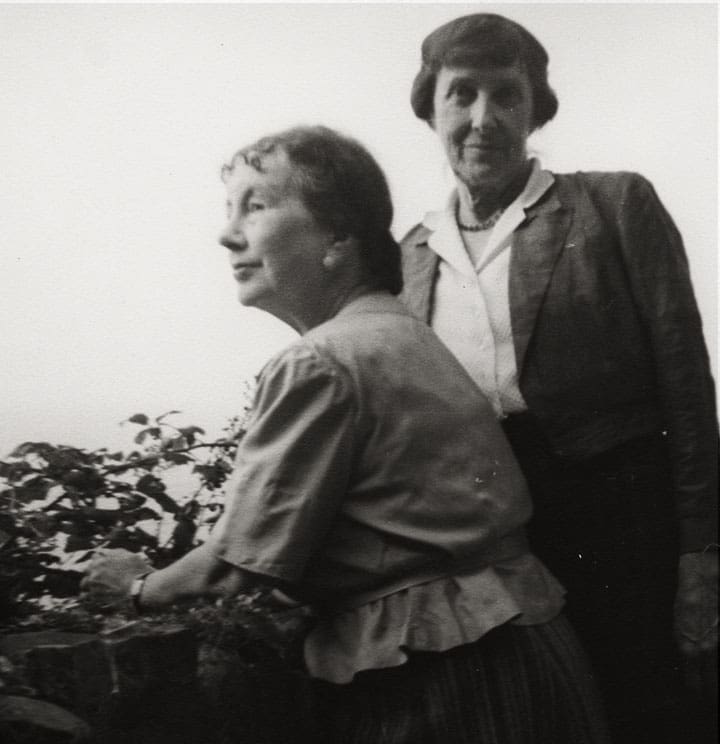
Every year, Mary Stella Edwards listed all the books she had read in the last 12 months in her journal. For example, in 1918 alone Mary Stella Edwards read at least 84 books. I write ‘at least’ because Edwards only included the books that she read from beginning to end in these annual lists – which means that the poetry was usually excluded. In contrast, since 2010 the number of adults reading books for pleasure in the UK has declined sharply – which is uncoincidentally around the time that smartphones became widely available. Things have become so bad that The National Literacy Trust has designated 2026 ‘The National Year of Reading’ in an attempt to revitalise the UK’s enthusiasm for novels.
It’s clear from Edwards’ journals that she saw her voracious reading habit as completely normal. She rarely bothers to even name the poet or author she’s quoting in either her journals or letters – simply assuming that her reader will already know who the quote is from. And it seems the recipients of her letters did know. It’s her 21st century readers who have to look up the quotes on the internet!
The importance of reading
These annual book lists – which she began as a teenager – are enormously helpful in tracking Edwards’ influences. They are one of the many reasons that the archive is such a valuable resource for artists and historians. It’s also a rare resource. In 1991 the researcher Alison Light1 wrote that the reading habits of the majority of British people – especially women – are rarely even mentioned in research about the 20th century. And the archive contains not only her lists of reading, but also their impact. Mary Stella Edwards had her own code for showing the importance of the books she read – underlining the books she particularly loved once, twice or even three times. She marks books read more than once with a circle. She gave the guilty pleasures, or “piffle” as she called them, a cross in the margin – but she still included them.
Among the expected classics are literally hundreds of books that, although well-received at the time, are now almost completely forgotten. I wonder how many books described as ‘instant classics’ in our own century will be similarly forgotten. It was only on learning about the decline of reading in the last two decades that I began to understand just what an impact this kind of shared cultural knowledge must have had on Edwards and her friends. Poetry and novels underpin so much of their thinking. They share quotes in their letters, illustrating their thoughts, or to expand the scope of what is being written, or both.
Discussions about books and reading forms such a significant proportion of the letters between Mary Stella Edwards and Judith Ackland that it’s difficult to pick out individual examples. However, I’m going to include two extended quotes from letters and journals that have particularly caught my attention in the last few months. By a strange coincidence, both anecdotes include (the unfortunately named) Mr. Moister.
Mr Moister’s outrage
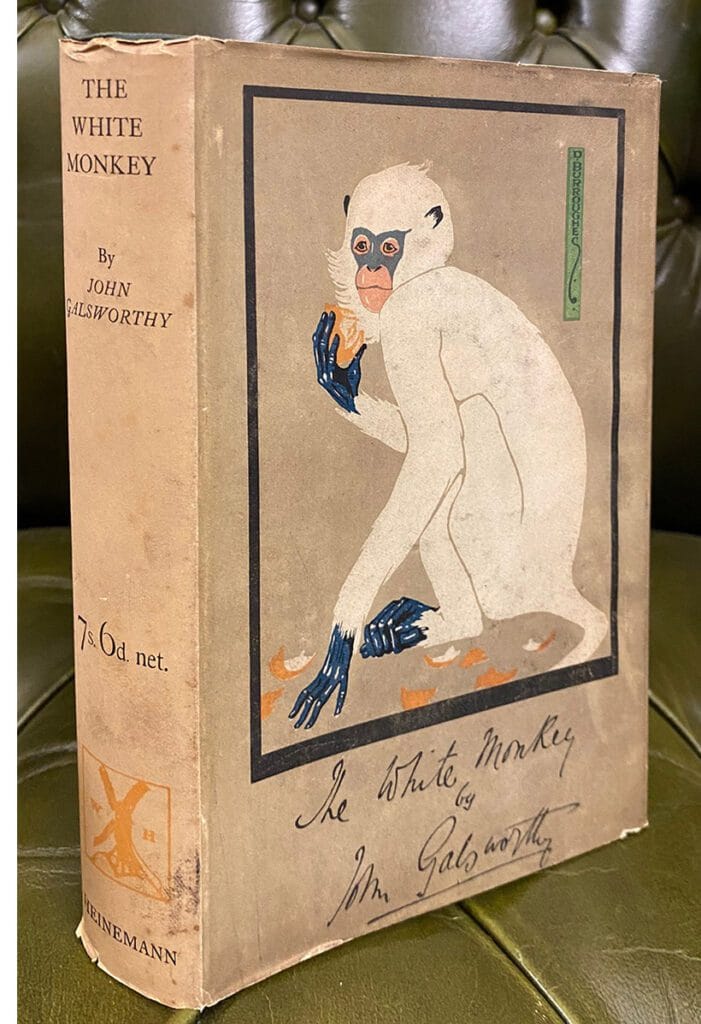
This is a colourful story, recounted as a piece of theatre in a letter to Judith in August 1925. Two pieces of context: The White Monkey is the fourth novel in The Forsyte Saga by John Galsworthy. And second, Edwards’ father encouraged her reading from an early age – reading aloud to her and giving her free access to his own book collection. Not all young women were quite so lucky…
I must tell you a delicious thing that happened to Father, though he is afraid that it may earn him the reputation of trying to corrupt the morals of young ladies!! … The scene is the Free Library at the Council School – the characters Father and a Mr. Moister – both School Managers. On a previous Library evening F. has recommended “The White Monkey” to Mr M and this is what followed.
Mr M. (Tall, nervous, white-haired; a Plymouth Brother and a total-everything you can think of; with a prim wife and twin daughters one of whom is going to be married, aged now 23 or 24): Good evening Mr Edwards. I’ve brought back that book – “The White Monkey” It’s rather – um – er…. My wife said to me “Well I don’t think much of Mr. Edwards’ taste in books!”
F. looks up surprised.
“And the worst of it is that before I had time to stop them both the girls had read it!”
F. But what on earth do you think’s the matter with it?
Mr M. (lowering his voice.) Well, there’s a scene in it about a child being born!!![…]
Isn’t it appalling to think there are still people being brought up in houses like that.
Mr M. has turned again to the shelves and is seeking a book suitable for young ladies when in bursts my friend Ethel Palmer, sees Mr M’s doubtful expression and going to him says “If you’re looking for a good book, let me recommend ‘The White Monkey’!”
The curtain falls.
Mr Moister is most insistent
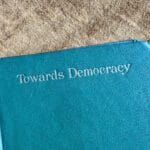
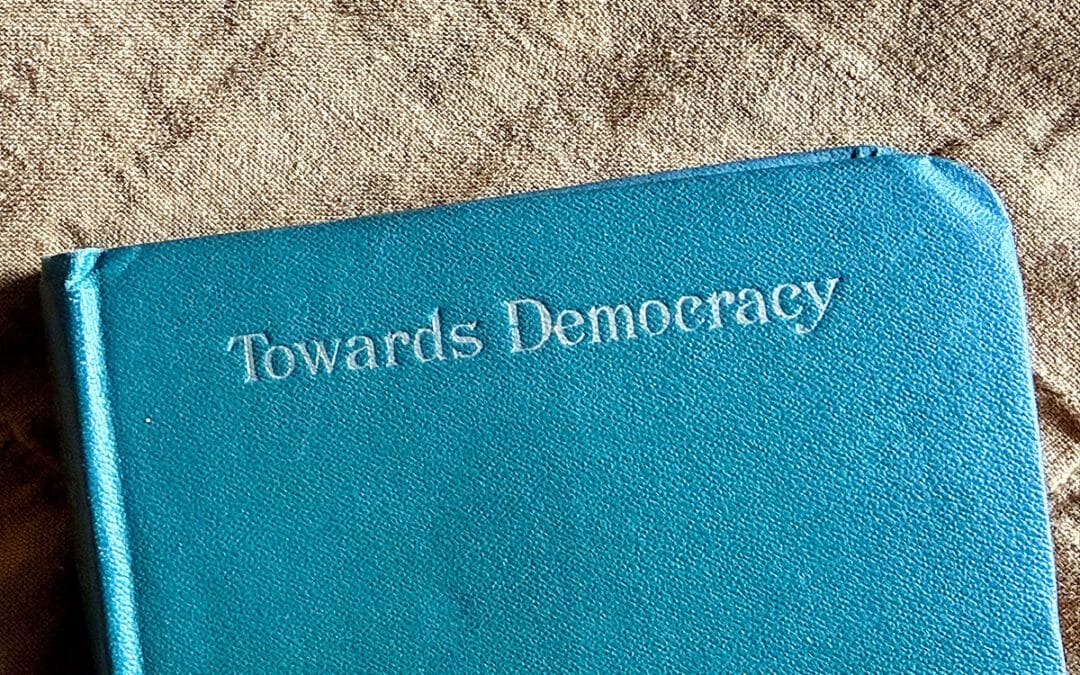
In March 1920 Mary Stella Edwards bought a copy of Towards Democracy by Edward Carpenter, which she loved so much that she carried it in her pocket wherever she went for most of that year. Carpenter was a socialist and gay rights activist (among many other things) and he also inspired E.M. Forster’s novel Maurice. I imagined his book would be a series of essays on the importance of giving the vote to everyone, regardless of class or gender. However, when I bought a copy, I found it to be a long prose poem on freedom and equality (again, among many other things!) with an unusual-for-the-time attitude towards the natural world which already felt familiar to me from Mary Stella Edwards’ work. In short, it feels like an important key to understanding her thinking from this time.
In October 1920 however, the book got her into a slightly embarrassing situation at Staines Town Hall, thanks to Mr. Moister’s insistence that she speak at a talk on Democracy. For context: in 1920 only women over 30 with a certain amount of property had the vote. Mary Stella was 22 at this time. The following excerpt comes from her journal (E.C. is her abbreviation for Edward Carpenter):
Gerald Tetley […] came down to the Staines Literary and Debating Society and spoke in the Town Hall on “The Meaning of Democracy.” I had E.C.’s book in my pocket, and intended to ask him if he’d read it. The whole lecture was a tracing of political freedom from its first glimmerings to the present time (shackled still!) I listened to it with growing despair, and at the end, when Mr Jones had moved the vote of thanks the Chairman (Mr. Moister) would insist on catching my eye. I looked away – but it was no use. When I looked back it was still fixed on me. I rose to second the vote of thanks!
“I am glad to have this opportunity of thanking Mr Tetley. I was eager to know what would be his exposition of the word Democracy; and I have listened eagerly for this exposition, up till the last sentence but three of this address, I listened in vain, and even then I did not quite understand. May I ask Mr Tetley if he gives to the word Democracy only a political meaning?”
I sat down amid a disastrous silence, a chilliness of atmosphere which showed that they thought me mad. The Lecturer and the Chairman both looked startled; then Gerald Tetley stood up, and in a few polite and chilly words referred me to the Dictionary. Thus ended my first speech in the Town Hall. Fool! – to myself. And to him – blind! Why couldn’t I explain what I meant; that the people must have freedom of the soil, Democracy of the intellect, the soul, the personality, before they can attempt government “of the people, by the people, for the people.” Now we have gone our separate ways, both misunderstanding. I shrunk out the Hall feeling cold and cowed.
Reading and democracy
In 2026 democracy has become a hot topic once again. Some journalists have started to connect the decline in long-form reading with a threat to democracy itself – which, as Mary Stella Edwards pointed out, is more than just having the vote. Last year The Times columnist James Marriott wrote an essay on substack with the gloomy title The dawn of the post-literate society: and the end of civilisation. It’s over 4500 words long, but became an online and podcast talking point.
This essay led to a three-part BBC Radio 4 series: How Reading Made Us (available in all countries) in which Marriott documents how learning to read as children changes the wiring of our brains and helps to develop empathy. But he goes further, showing how increasing literacy and the availability of books in the last two centuries changed society itself, making democracy possible. Now, with the decline in long-form reading and the rise of attention-grabbing shortform video, he fears that our democracy is facing a new threat, as people lose skills of critical thinking and wider empathy with others. I do hope he’s wrong.
Yet there is hope…
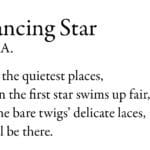
I normally include a poem by Mary Stella Edwards in these blogposts, but this time here is the poem ‘Squinancy-Wort’ from Towards Democracy, by Edward Carpenter. It’s an odd one. See if you can spot the dinosaurs and the post-humanism.

Squinancy-Wort
What have I done? –
I am a little flower,
Out of many a one
That twinkles forth after each passing shower.
White, with a blushful glow,
In the sweet meadows I grow.
Or innocent over the hill tops sport and run. –
What have I done?
Many an age agone,
Before man walked on earth,
I was. In the sun I shone;
I shook in the wind with mirth;
And danced on the high tops looking out seaward – where I had birth
Web-footed monsters came
And into the darkness went
In ponderous tournament,
Many an age agone.
But on the high tops I dwelt ever the same,
With sisters many a one,
Guiltless of sin and shame! –
What have I done?
What have I done? – Man came,
Evolutional upstart one!
With the gift of giving a name
To everything under the sun.
What have I done? – Man came
(They say nothing sticks like dirt),
Looked at me with eyes of blame,
And called me “Squinancy-wort.”
What have I done? I linger
(I cannot say that I live)
In the happy lands of my birth;
Passers-by point with the finger;
For me the light of the sun
Is darkened. Oh, what would I give
To creep away and hide my shame in the earth!–
What have I done?
Yet there is hope. I have seen
Many changes since I began.
The web-footed beasts have been
(Dear beasts!) – and gone, being part of some wider plan.
Perhaps in his infinite mercy God will remove this Man!
Edward Carpenter
Next Blogpost: But would I were the sea…
- Alison Light (1991) Forever England: Femininity, Literature and Conservatism between the Wars.
↩︎