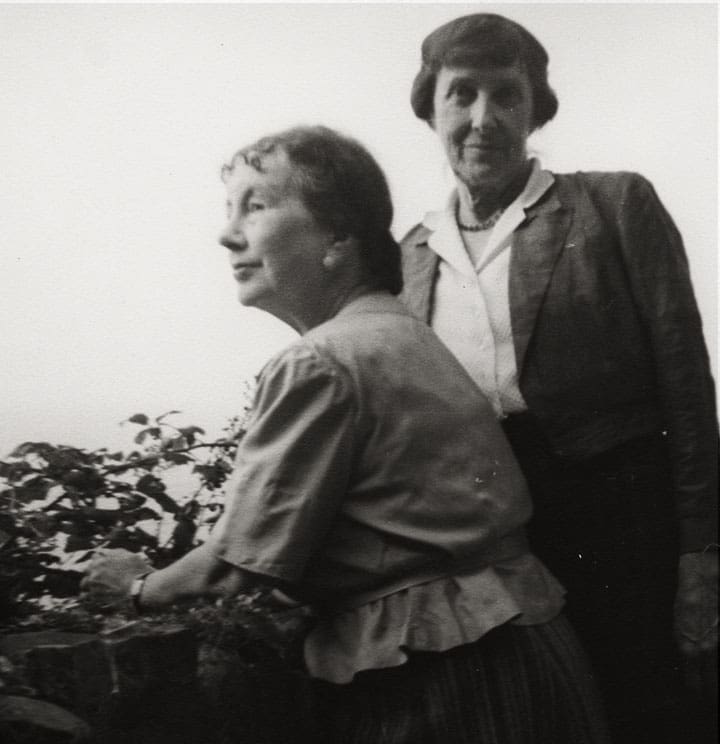
Mary Stella Edwards’ poetry changed in the mid to late 1920s – just at the time her first book of poetry was published by The Hogarth Press. The other-worldly connection to the natural world remained (see previous blogpost) but her focus was different. On the face of it, the reason for this change is obvious – she began staying at The Cabin in Bucks Mills with Judith Ackland in 1924. However, that isn’t the whole story. In this blogpost I will explore what changed after that first visit to The Cabin and why it made such a difference to her work.
A slow start
In her later years Mary Stella Edwards seems to have given the impression that she and Judith formed their relationship quite quickly at Regent Street Polytechnic in 1919-20. But the journals and letters reveal that their friendship developed slowly at first – partly because Mary Stella had such a wide circle of friends and finished her education at Regent Street much earlier than Judith, and partly because Judith had to return home to Bideford for long periods as two of her sisters, first Jean and then Madeleine, died of pulmonary tuberculosis. With Judith away in Devon so much, the two friends began writing to each other regularly in around 1920 – although the earliest letters I’ve found begin in 1923.
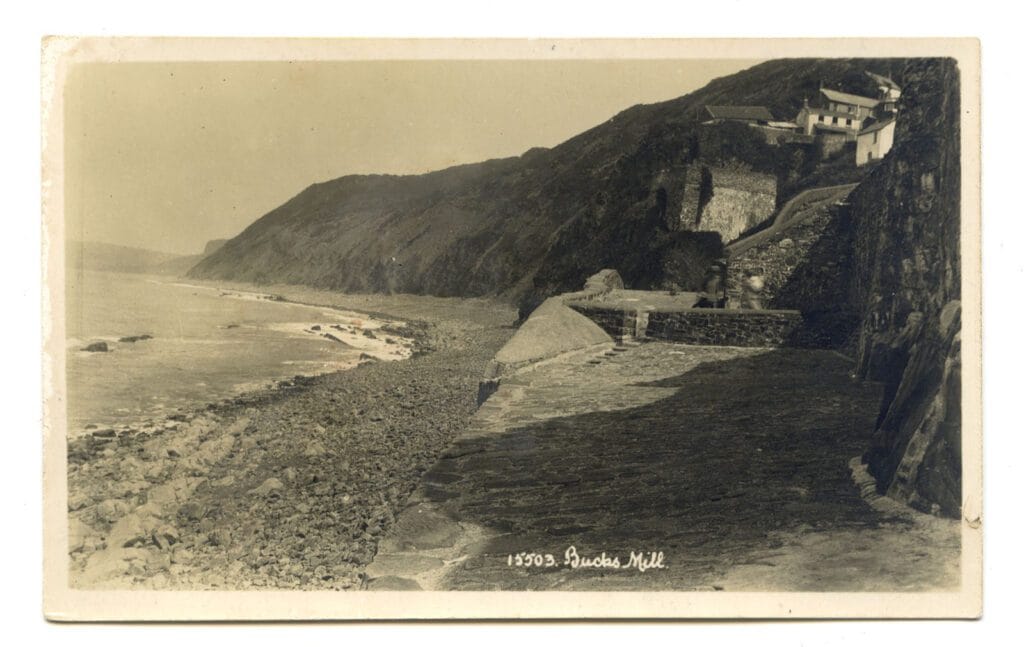
The two women became much closer in autumn 1923, when Mary Stella stayed with the Ackland family for the first time at Stowford House in Bideford. With the absence of Jean and Madeleine, the house was a quieter and much sadder place. In July 1923 Mary Stella wrote that she could join Judith at The Cabin in Bucks Mills, saying:
‘Of course I should love it. I went to Milford-on-Sea for a week after all, and did a great deal of swimming and made several new friends and had many hours of most interesting talk, chiefly about reincarnation.’
I must confess that I laughed out loud when I read this letter – and can quite understand why Judith may have wondered how Mary Stella – a real townie – would enjoy being in a cottage without sanitation in a remote fishing village. But perhaps it wasn’t just the lack of sanitation at The Cabin that was giving Judith pause. Mary Stella continued her letter:
‘Don’t hesitate to say if you think I’m in the wrong mood for the cottage – or for Bideford – or if you’d rather do anything else.’
Even as late as 1923, the differences in character and background between the two women led to misunderstandings, occasional disagreements and frequent awkward silences. Reading Mary Stella Edwards’ journal from 1920 onwards, I realise how contemporary she is in her behaviour. She’s so open to new experiences, and friendships, and intense conversations – and seems not to notice the chaos this attitude creates around her. Young men frequently fell at her feet (metaphorically) while she remained utterly oblivious to them. It makes her early journals enormously fun to read!
All this is to say that it took some time before Judith Ackland was sufficiently sure of Mary Stella Edwards to share The Cabin with her. The weeks spent with Judith and her family in autumn 1923 were a success and brought them much closer – but they did not go to The Cabin together that year.
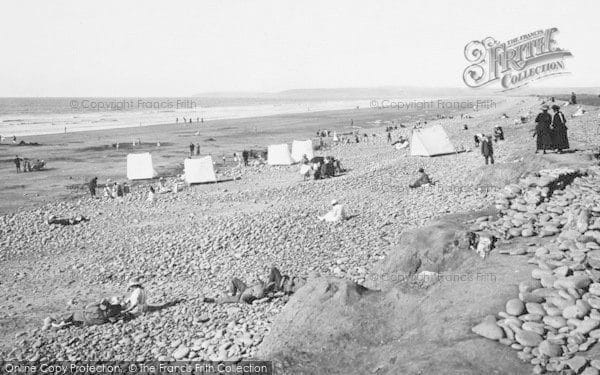
https://www.francisfrith.com/westward-ho/westward-ho-the-beach-1923_75132
‘An imperfect relation’?
After Mary Stella returned home from Bideford in late October 2023, she included this extraordinary statement in one of her letters:
‘And thinking of poems, I believe I shall never write one for you. I think I write them during an imperfect relation to fill the blanks and supply with imagination what reality lacks… with you I have too much real satisfaction to need to drug myself with verse…’
This statement helped me to understand why some of Mary Stella’s early poems seem a little unreal. She writes as a man in a few of these poems – which is something that a lot of women poets did at the time – and these have always felt quite theatrical to me. She also writes as sand on the beach and as a tree. In others I can’t be sure whether she’s writing as herself or as someone else. What does she mean by ‘an imperfect relation’? If these poems are creating an idealized version of ‘an imperfect relation’ with another person, then that would be very revealing – and would make sense of the wild intensity of some of these early poems.
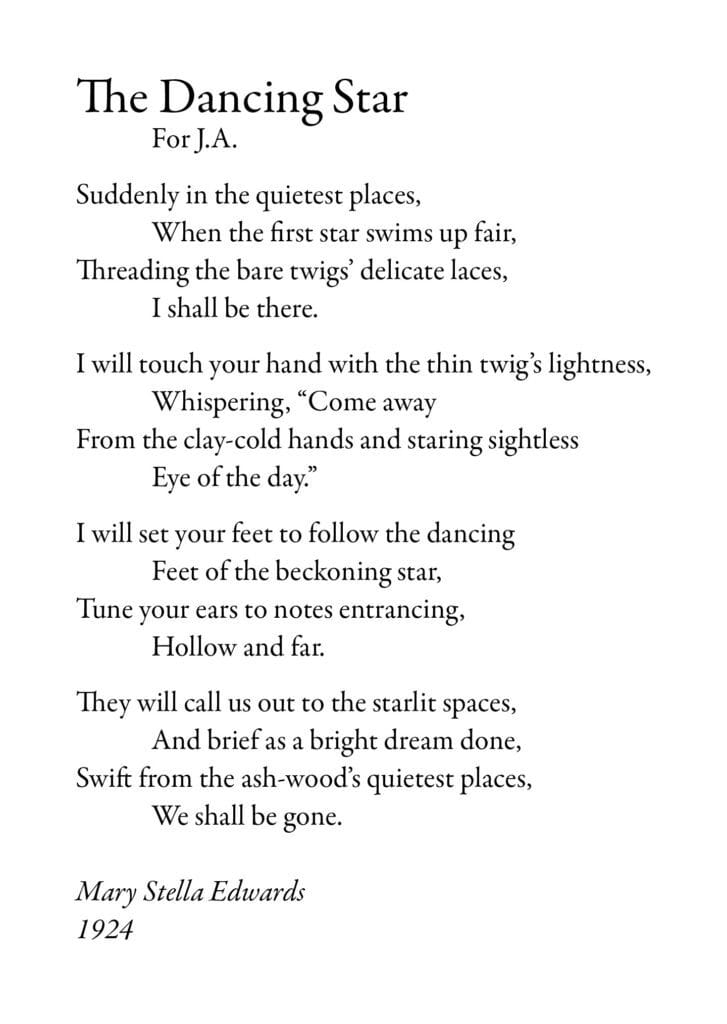
The Dancing Star
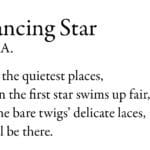
Almost exactly a year later in October 2024, after the two women had spent an idyllic time together in The Cabin, she wrote enclosing her first poem for Judith – The Dancing Star – that she had started on the train home from Bideford. She wrote:
‘My dearest dear, I made this poem for you as the train leapt along the splendid level after Sidmouth junction’ She continued: ‘I send it to you in faith, not knowing exactly what it means, except that I was thinking of your little ash-tree and of what a silvan-green mind you have, and of how we walked with silver faces, following adventure along the Clovelly road. The poem is not as good as I meant it to be and is difficult to read aloud, but I want you to love it if you can. You will at any rate share my delight at having begun to write again, and be glad to be the cause of it.’
The poem’s title – The Dancing Star – was inspired by Robert Lynd’s introduction to Methuen’s Anthology of Modern Verse in which he wrote that: ‘poetry was born like Beatrice under a dancing star’ (a reference to Shakespeare’s Much Ado about Nothing).
On first reading, it seems that Mary Stella is the ‘I’ of the poem. Reading it again now, after reading her letter to Judith, I realise for the first time that the first-person narrator of the poem is much more likely to be Judith herself. This would change the poem entirely – making it even deeper and richer – and prefiguring Judith’s life-long importance to Edwards’ work. Mary Stella’s letter continued:
‘It is strange I once thought I should never write a poem for you. I remember saying then that I usually wrote them (subconsciously at the time) to complete an imperfect relation – to drag poetry out of the failing cadences of prose. But that is not in the slightest degree the case with you. And I think you will see that it is different in essence from the ones I have written for other people. I suppose it is really a hailing and following of the spirit of poetry I discover in you – or rather, both of us hailing it within and without ourselves.’
‘The Dancing Star’ was to be just the first poem of many that Mary Stella would write for Judith. In 1980, nine years after Ackland died, Mary Stella wrote to tell the poet May Sarton that she had just written her 101st poem for Judith.
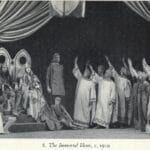
Previous blog: Mary Stella Edwards and “The Immortal Hour”